
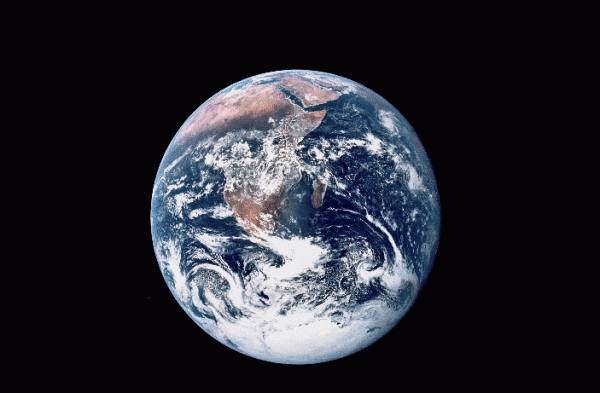
According to the sources, NASA describes the evidence for climate change as “unequivocal,” stating that the Earth is warming at an “unprecedented rate” with human activity as the “principal cause”.
While the sources regarding the history of science acknowledge that “some discoveries have done far more harm than good” and list several “massive blunders” or “tenuous theories” like luminiferous aether, phrenology, and racial classification, they treat the current scientific understanding of climate change differently due to the nature of the evidence.
The scientific consensus on climate change is supported by the following factors in the sources:
- Vast Data Collection: NASA operates more than 20 satellites in orbit and uses tens of thousands of meteorological stations, as well as ship- and buoy-based instruments, to assemble global temperature records.
- Observed Reality: Scientists are not just relying on theories; they are observing effects that were previously predicted, such as melting glaciers, sea level rise, and more intense heat waves.
- Advanced Modeling: The consensus is backed by high-performance computing and Earth system modeling that analyzes “terabyte- to petabyte-scale datasets”.
- Physical Mechanism: The warming trend is attributed to the well-understood “greenhouse effect,” where the atmosphere traps heat radiating from Earth due to increased concentrations of atmospheric carbon dioxide from burning fossil fuels.
In contrast to the “mistake” of human race classification—which the sources describe as an arbitrary “invention” that lacked biological reality from its inception—the evidence for climate change is presented as a conclusion drawn from decades of “critical long-term observations”. The sources indicate that the effects of human-caused warming are “happening now” and are considered “irreversible for people alive today”.